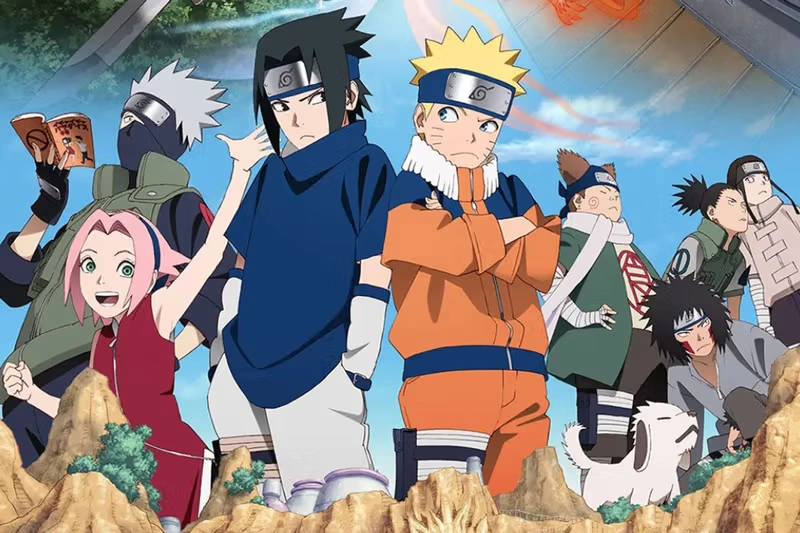
Naruto Story: From Social Outcast to Ninja Legend | For generations growing up in the 2000s, the name Naruto Uzumaki is instantly recognizable. This blonde-haired ninja clad in vibrant orange has established himself as a global pop culture icon. However, behind the massive success lies a long journey fueled by dedication, deep philosophy, and boundless creativity from its creator, Masashi Kishimoto.
Through his artwork, Kishimoto does not merely deliver breathtaking martial arts battles. He weaves an emotional narrative about self-acceptance, hard work, and the true meaning of peace.
Creative Roots: The Genesis of the Ninja
The journey of this masterpiece began long before its first official volume hit the shelves. In 1995, Masashi Kishimoto created a one-shot manga titled Karakuri. This early work caught the attention of the Japanese comic industry, earning him the prestigious Hop Step Award from Shueisha, an honorable recognition for rising artists. This success served as a crucial stepping stone that fueled Kishimoto’s creative drive.
Two years later, in 1997, Kishimoto released the initial draft of Naruto as a one-shot comic. Although the concept differed slightly from the final version—where the main character was originally envisioned as a nine-tailed fox taking human form—the core intrigue and charm were already visible. The positive reception from readers ultimately convinced the publisher to greenlight a weekly serialization.
Narrative Structure: Two Pillars of a Compelling Life
In September 1999, Shueisha’s Weekly Shōnen Jump officially published the first chapter of this long-running series. The story spanned 15 years, concluding in November 2014 with a total of 700 chapters collected into 72 tankōbon volumes. Structurally, Kishimoto divided the ninja’s journey into two major, interconnected parts.
Part One: Pre-Adolescence and the Search for Identity
Spanning volumes 1 to 27, the initial part focuses on the main character’s childhood and early youth. Readers are introduced to a socially isolated orphan, shunned by his fellow villagers due to the monster sealed inside him. The narrative centers on his explosive ambition to become the Hokage—the supreme leader of his village—solely to gain acknowledgment from those around him. Here, the values of friendship, healthy rivalry, and rookie team dynamics form a solid foundation.
Part Two: Adulthood and Ideological Conflicts
Covering volumes 28 to 72, the story takes a time-skip of several years. The characters have grown both emotionally and physically. The conflicts evolve from simple ninja exams to inter-village political struggles, international criminal threats, and full-scale war. This segment explores darker themes, such as the cycle of hatred, sacrifice, and maintaining one’s principles in a world full of compromise.
Media Expansion: From Pages to the Screen
The skyrocketing popularity of the manga caught the attention of animation studios Pierrot and Aniplex, leading to an audiovisual adaptation. The first anime series aired in October 2002 on TV Tokyo. Following the manga’s structure, the television adaptation was divided into two iconic titles, broadcasting continuously until March 2017.
The franchise’s expansion did not stop at television; it permeated various sectors of the entertainment industry. Studio Pierrot produced 11 animated feature films that expanded the universe, alongside 12 Original Video Animations (OVAs) offering extra content for loyal fans. This success naturally flowed into the gaming industry across multiple console generations, light novel publications, and highly collectible trading card games.
When the father’s story concluded, the franchise did not fade away. The narrative baton was passed down through the sequel series, Boruto. Focusing on the next generation, specifically Naruto’s eldest son, Boruto Uzumaki, the story explores a young boy trying to forge his own ninja way beneath the massive shadow of his legendary father.
Global Dominance and Astounding Sales Records
Statistical data serves as undeniable proof of how this work broke geographical and cultural boundaries. To date, more than 250 million copies of the manga are in circulation worldwide. This milestone places it in an elite rank as one of the best-selling manga series of all time.
In North America, Viz Media acted as the official licensee, publishing the series both digitally and in print. The story’s resonance in the Western market was extraordinary. The English translations frequently topped prestigious bestseller lists, including USA Today and The New York Times. In 2006, the seventh volume made history by winning a Quill Award, a distinguished literary honor in the United States rarely achieved by translated graphic novels.
Critical Breakdown: Why Is This Story So Beloved?
The success of any artwork relies heavily on the quality of its content. Literary critics and pop culture analysts consistently praise several key elements brought forward by Masashi Kishimoto.
-
Dynamic Character Development: One of the core strengths lies in its multi-dimensional characters. Even the antagonists are given profound backstories and humane motives, allowing readers to understand, or even sympathize with, their actions. The protagonist’s emotional maturity from a rebellious child into a wise protector is written organically.
-
Emotional Storytelling: The story possesses an incredible ability to move its audience. Moments of loss, reunions, and sacrifices are crafted with high dramatic sensitivity, making readers feel as though they are growing alongside the characters.
-
Deep Philosophical Themes: Beneath the exciting battles lies a profound exploration of coming-of-age themes. Kishimoto seamlessly weaves rich cultural references, ranging from traditional Japanese mythology and Shinto beliefs to Confucian values regarding loyalty, respect, and social responsibility.
Nevertheless, the masterpiece is not without its flaws. Some critics pointed out pacing issues in certain arcs, particularly toward the finale, where prolonged battle scenes were viewed as dragging down the main plot. In the anime adaptation, the excessive amount of filler episodes also sparked debate among fans. However, these criticisms did not diminish the global adoration for the franchise.
An Enduring Cultural Legacy
More than just an entertaining comic, this ninja saga has transformed into a macro-cultural phenomenon. Its core values—never giving up, breaking the cycle of hatred, and staying loyal to friends—have inspired millions worldwide. Its iconography, from the forehead protectors with swirling crests to the signature arms-backwards running style, has become a universal language recognized across generations.
Through over a decade of storytelling, Masashi Kishimoto proved that a story deeply rooted in local Japanese culture can achieve universal appeal when built upon genuine human values. This legacy is certain to live on, continuously read and embraced by generations to come.